












 May 31, 2026
Modern SAP applications rarely operate in isolation. They constantly interact with external systems, legacy applications, APIs, cloud services, and various business components. As organizations embrace SAP RAP and ABAP Cloud, designing applications that are flexible, maintainable, and easy to extend has become more important than ever.
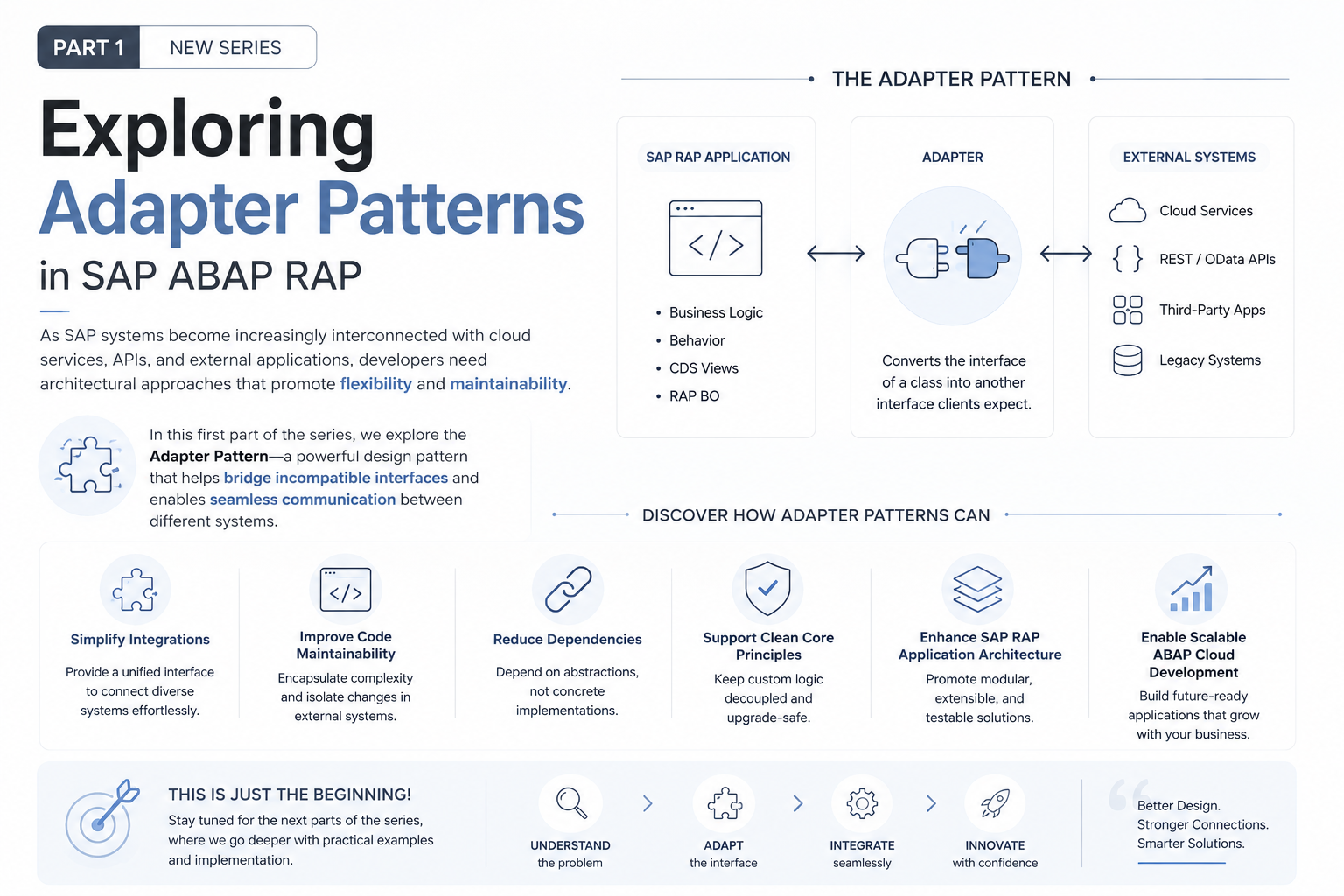
In Part 1 of this series, we explore one of the most powerful and practical software design patterns used in enterprise development—the Adapter Pattern.
The Adapter Pattern acts as a bridge between incompatible interfaces, enabling different systems and components to communicate seamlessly without requiring major modifications to existing code. Within SAP ABAP RAP applications, this pattern helps developers decouple business logic from external dependencies, resulting in cleaner architecture and improved maintainability.
In this session, we will cover:
✅ What is the Adapter Pattern and why it matters in enterprise software development
✅ Understanding the role of adapters within SAP ABAP RAP architecture
✅ How adapter patterns improve flexibility, scalability, and code reusability
✅ Integrating legacy systems with modern RAP-based applications
✅ Reducing system dependencies and simplifying future enhancements
✅ Applying clean architecture principles in ABAP Cloud development
As SAP landscapes continue to evolve with cloud technologies, developers need architectural patterns that support change without disrupting existing business processes. Adapter Patterns provide exactly that capability by creating a stable layer between business logic and external integrations.
Whether you are developing RAP applications, working with APIs, integrating third-party services, or modernizing legacy SAP solutions, understanding the Adapter Pattern is an essential skill for building enterprise-grade applications.
Understanding design patterns is not just about writing better code—it’s about building applications that can evolve with changing business requirements.
Join me as we explore practical SAP RAP development techniques and enterprise architecture best practices.
Stay tuned for Part 2, where we will move from concepts to implementation and real-world SAP RAP scenarios.
#SAPABAP #SAPRAP #ABAPCloud #AdapterPattern #SoftwareArchitecture #DesignPatterns #SAPDevelopment
https://drive.google.com/file/d/1Vr5zbICkkiWBXJtl_9hspnCP4evOpVX6/view?usp=sharing




 Prev Post
What do you think?
Show comments / Leave a comment