












 May 31, 2026
Bridging Legacy Systems and Modern RAP Applications
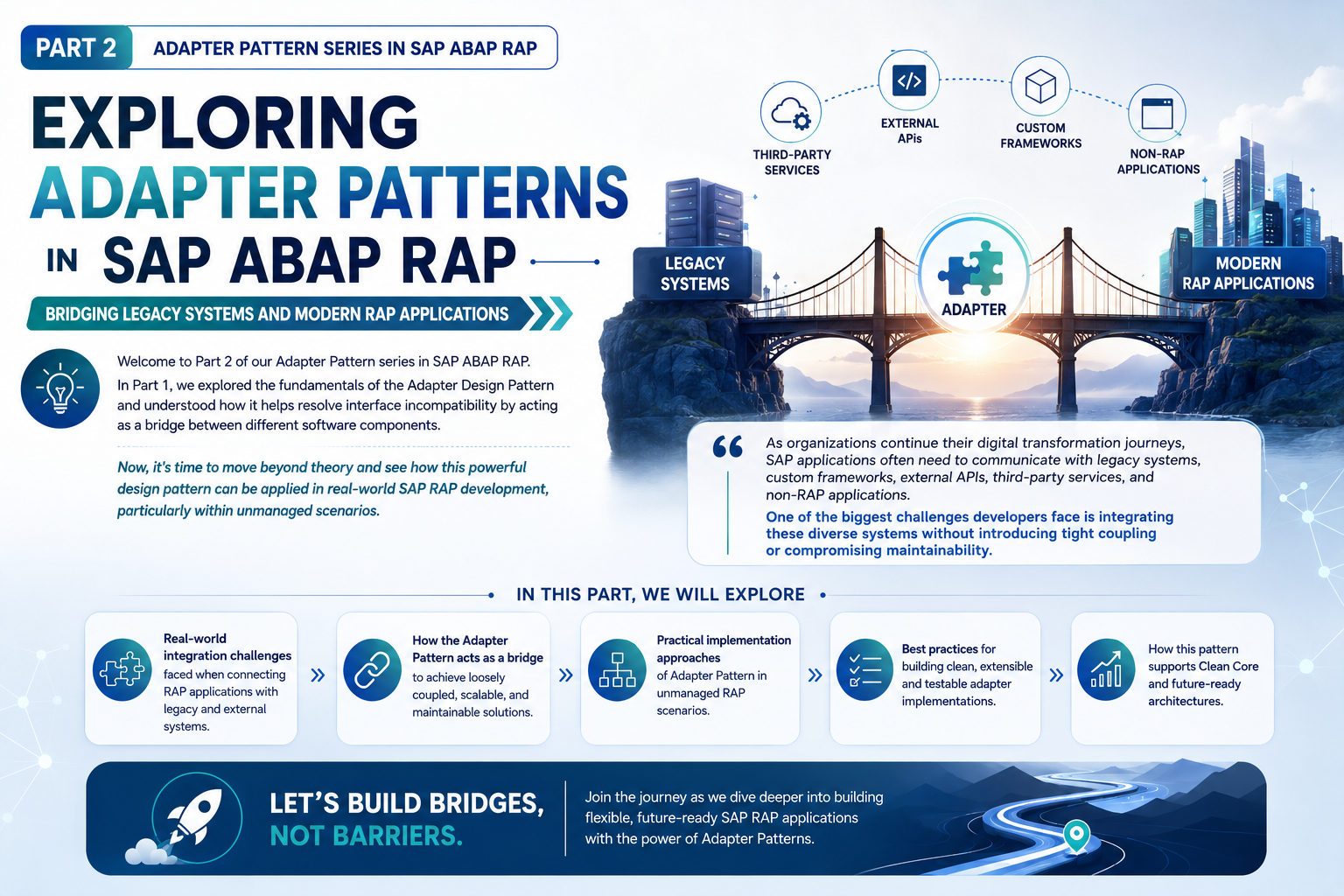
Welcome to Part 2 of our Adapter Pattern series in SAP ABAP RAP.
In Part 1, we explored the fundamentals of the Adapter Design Pattern and understood how it helps resolve interface incompatibility by acting as a bridge between different software components. Now, it’s time to move beyond theory and see how this powerful design pattern can be applied in real-world SAP RAP development, particularly within unmanaged scenarios.
As organizations continue their digital transformation journeys, SAP applications often need to communicate with legacy systems, custom frameworks, external APIs, third-party services, and non-RAP applications. One of the biggest challenges developers face is integrating these diverse systems without introducing tight coupling or compromising maintainability.
This is where the Adapter Pattern becomes a game-changing architectural solution.
In this chapter, we explore how Adapter implementations within SAP ABAP RAP unmanaged applications create a clean separation between RAP business objects and external system interfaces. Instead of embedding integration logic directly into business behavior implementations, adapters provide a dedicated abstraction layer that translates requests and responses between incompatible systems.
Key topics covered include:
✅ Understanding Adapter Pattern implementation in RAP unmanaged scenarios
✅ Integrating legacy SAP applications with modern RAP business objects
✅ Creating reusable abstraction layers for external services
✅ Decoupling business logic from integration-specific code
✅ Improving maintainability, extensibility, and testability
✅ Supporting Clean Core and modern SAP architecture principles
✅ Reducing the impact of future system migrations and interface changes
A well-designed adapter architecture ensures that changes in external systems require minimal modifications to the RAP application itself. This approach not only protects existing investments but also enables organizations to modernize gradually while maintaining operational stability.
Through practical implementation examples, developers will gain insights into how adapter classes can encapsulate communication logic, standardize data transformations, and provide a consistent interface to RAP business behavior implementations.
For SAP developers working with ABAP Cloud, RAP, APIs, OData services, BAPIs, RFC-enabled function modules, or legacy ECC integrations, mastering the Adapter Pattern is a critical step toward building scalable and future-ready enterprise solutions.
The true strength of SAP RAP lies not only in developing transactional applications but also in architecting solutions that can adapt to constantly evolving business and technical landscapes. Adapter Patterns provide the flexibility required to achieve this goal.
Join me as we continue this architectural journey and uncover practical techniques for creating robust, maintainable, and integration-friendly SAP RAP applications.
In Part 3, we will explore advanced adapter implementations, testing strategies, and architectural best practices for enterprise-scale RAP solutions.
https://drive.google.com/file/d/1yd4xIM43DwCPNJGzIDizJ9r317LyoQg8/view?usp=sharing




 Prev Post
What do you think?
Show comments / Leave a comment