











 June 3, 2026
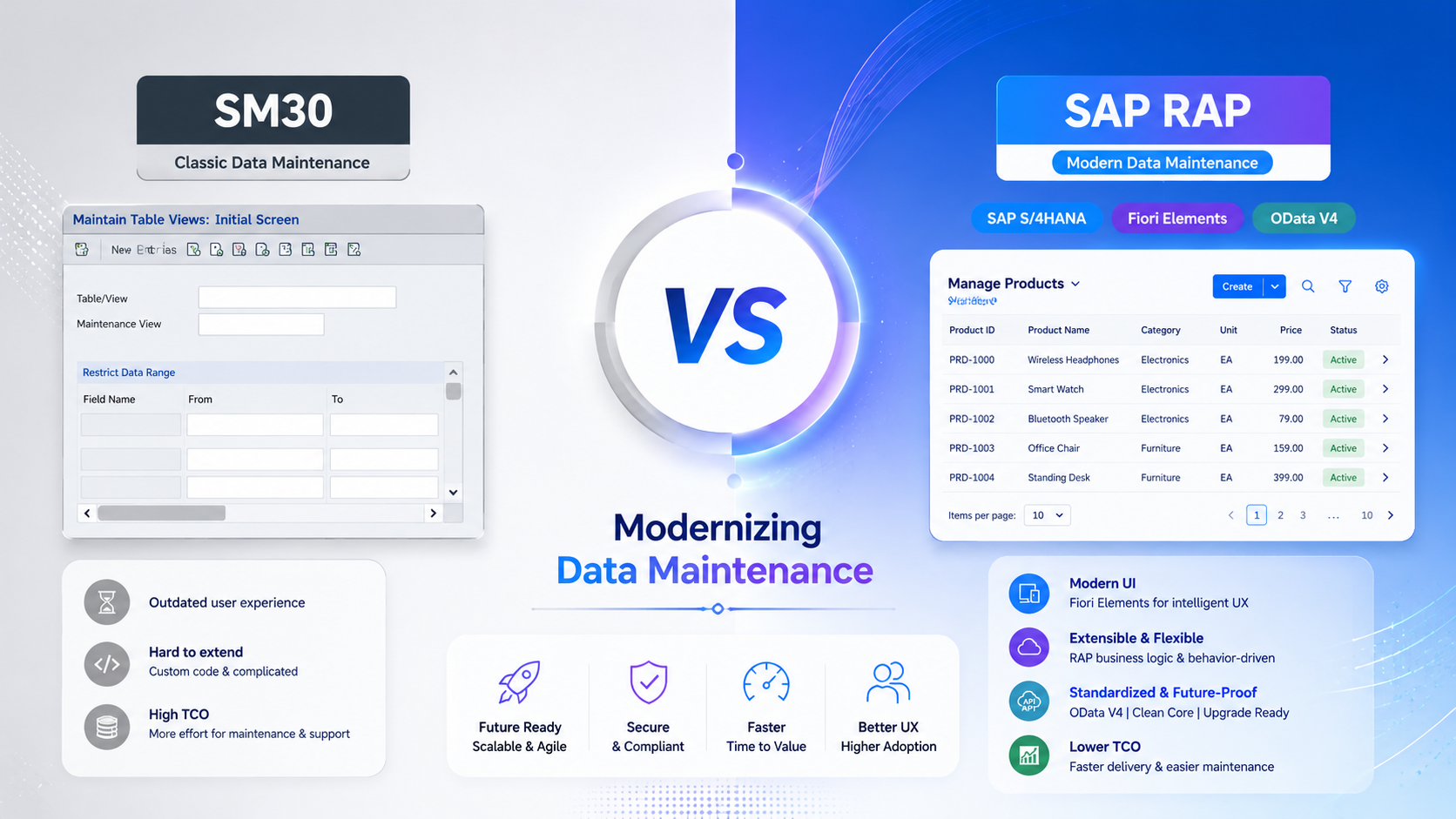
For decades, transaction SM30 has been the go-to tool for maintaining custom configuration and master data within SAP systems. While SM30 remains effective for basic table maintenance, modern business applications require significantly more than simple CRUD operations.
Today’s SAP users expect responsive SAP Fiori applications, business validations, draft handling, role-based security, value helps, search capabilities, and seamless integration with enterprise processes.
This is where the SAP ABAP RESTful Application Programming Model (RAP) transforms the development landscape.
In this article, we explore how SAP RAP provides a modern alternative to traditional SM30 maintenance screens by enabling developers to generate complete enterprise-grade applications with significantly reduced development effort.
Using RAP generators available in SAP S/4HANA and ABAP Cloud environments, developers can automatically create repository objects including CDS Views, Behavior Definitions, Service Definitions, Service Bindings, Metadata Extensions, and OData Services.
Through a practical Claim Management scenario, we demonstrate how RAP dramatically simplifies application development while delivering a superior user experience through SAP Fiori Elements.
The guide covers both SAP BTP ABAP Environment (ABAP Cloud) and SAP S/4HANA On-Premise development approaches, helping developers understand the differences and opportunities available in each landscape.
By the end of this tutorial, readers will understand why RAP represents the future of SAP application development and how it enables organizations to modernize legacy maintenance processes with intelligent, scalable, and user-friendly business applications.
Topics Covered
1. Traditional Data Maintenance with SM30
- Overview of SM30
- Table Maintenance Generator
- Strengths and Limitations
- Typical Business Scenarios
2. Why Modern Enterprises Need More Than SM30
- SAP Fiori Expectations
- User Experience Challenges
- Business Validation Requirements
- Enterprise Scalability
3. Introduction to SAP RAP
- RAP Architecture Overview
- Business Object Concepts
- Metadata-Driven Development
- SAP Fiori Integration
4. Creating the Business Table
- Claim Header Table Design
- Business Data Structure
- Persistence Layer
5. Generating Sample Data
- ABAP Class Development
- Test Data Population
- Data Validation
6. RAP Generator Framework
- Repository Object Generation
- Automatic Artifact Creation
- Productivity Improvements
7. Generated RAP Artifacts
Root View Entity
- Business Object Foundation
- CDS Modeling
Metadata Extension
- UI Configuration
- Annotation Management
Behavior Definition
- CRUD Operations
- Business Rules
Access Control
- Authorization Management
- Security Implementation
Service Definition
- Business Service Exposure
Service Binding
- OData V4 Publication
8. ABAP Cloud Development
- RAP Development in BTP
- Cloud-Ready Applications
- Modern Development Standards
9. SAP S/4HANA Development
- On-Premise RAP Development
- Draft Tables
- Generated Objects
- System-Specific Considerations
10. SAP Fiori Preview
- Application Launch
- Data Maintenance Experience
- User Interface Review
SM30 vs RAP Comparison
SM30
✔ Quick Table Maintenance
✔ Minimal Setup
✔ Technical User Focus
✖ Limited User Experience
✖ No Draft Handling
✖ Limited Extensibility
✖ No Modern Fiori Design
SAP RAP
✔ SAP Fiori Ready
✔ Draft Support
✔ Business Validations
✔ OData APIs
✔ Role-Based Security
✔ Enterprise Scalability
✔ Metadata-Driven UI
✔ Cloud-Ready Architecture
Key Benefits
✔ Replace legacy maintenance transactions
✔ Generate enterprise applications rapidly
✔ Deliver modern SAP Fiori experiences
✔ Reduce development effort
✔ Enable cloud-ready architectures
✔ Improve data quality through validations
✔ Enhance user productivity
✔ Future-proof SAP developments
https://drive.google.com/file/d/11jTB1dzuQiP9iw1mMxKl8cnBwiO_aY4W/view?usp=sharing




 Prev Post
What do you think?
Show comments / Leave a comment