












 June 1, 2026
After successfully setting up our SAP CAP development environment and creating our first CAP project in Day 1, it is time to move deeper into one of the most important aspects of enterprise application development: data modeling.
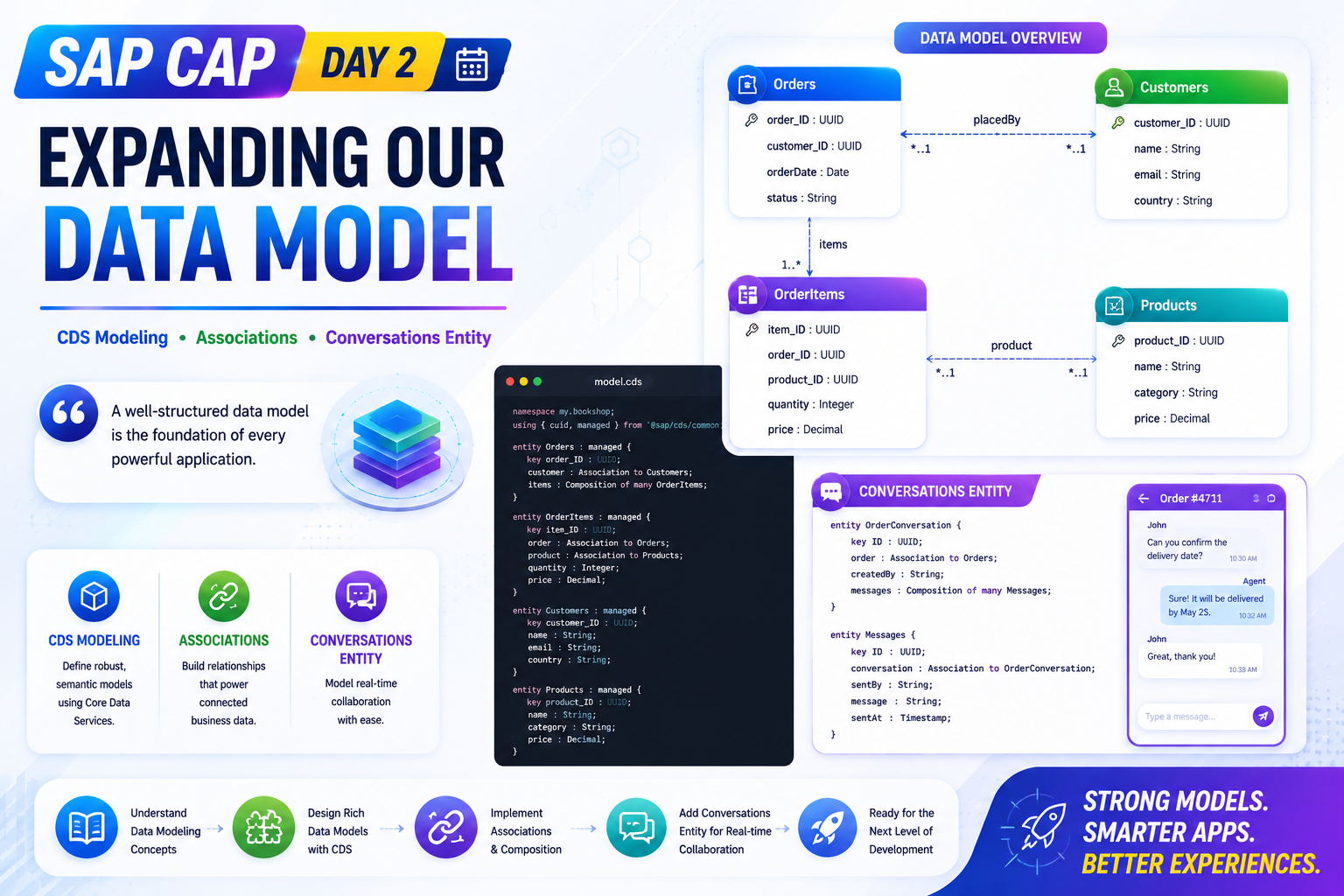
In Day 2 of our SAP CAP Learning Journey, we focus on extending our application by introducing a new business entity called Conversations. While creating entities may seem like a simple task, it represents a fundamental concept in CAP development—building relationships between business objects and creating a structured data model that reflects real-world business scenarios.
Data modeling is the foundation upon which every successful enterprise application is built. A well-designed model not only stores data efficiently but also enables meaningful business interactions, seamless integrations, and scalable application growth.
Through this hands-on exercise, we explore how SAP CAP leverages Core Data Services (CDS) to define entities, relationships, and associations in a simple yet powerful manner. CDS allows developers to describe business objects declaratively, reducing complexity while maintaining a clear and maintainable architecture.
A major focus of this chapter is understanding how entities communicate with one another through associations. By adding the Conversations entity to our existing model, we begin creating a connected application landscape where business data is organized logically and can be easily consumed by services, APIs, and SAP Fiori applications.
In addition to coding the entity definitions, we also explore the CDS Graphical Modeler available in SAP Business Application Studio. This visual representation helps developers understand entity relationships, validate designs, and communicate architecture more effectively.
By the end of this exercise, readers will gain practical experience in extending SAP CAP data models, creating associations, and preparing the foundation for future service exposure and application development.
Topics Covered
1. Recap of Day 1
- SAP CAP Fundamentals
- SAP BTP Setup
- SAP Business Application Studio
- Initial Project Creation
2. Understanding Data Modeling in SAP CAP
- Why Data Modeling Matters
- Business Object Design
- CAP Development Principles
- CDS-Based Modeling
3. Extending the Existing Data Model
- Updating the Database Layer
- Creating Additional Entities
- Organizing CDS Definitions
- Maintaining Clean Architecture
4. Creating the Conversations Entity
- Entity Structure
- Key Fields
- Business Purpose
- Entity Lifecycle
5. Defining Relationships
- Associations in CDS
- One-to-One Relationships
- One-to-Many Relationships
- Navigating Business Data
6. CDS Code Walkthrough
- Syntax Explanation
- Entity Definitions
- Association Modeling
- Best Practices
7. Exploring the CDS Graphical Modeler
- Opening CDS Models
- Visualizing Entity Relationships
- Understanding Data Flow
- Design Validation
8. CAP Architecture Benefits
- Reusable Models
- Simplified Development
- Future Scalability
- Cloud-Native Design
9. Preparing for Service Exposure
- Data Model Readiness
- OData Consumption
- API Generation
- SAP Fiori Integration
10. Lessons Learned
- Data Modeling Best Practices
- Common Design Mistakes
- Recommendations for CAP Developers
Key Takeaways
✔ Learn how to extend SAP CAP applications
✔ Create new entities using CDS
✔ Understand associations and relationships
✔ Explore graphical data modeling tools
✔ Build scalable enterprise data models
✔ Prepare applications for future service exposure
https://drive.google.com/file/d/1OWUkbex3_nCVnvXcHc9UsFg3hf7tq8c-/view?usp=sharing




 Prev Post
What do you think?
Show comments / Leave a comment